
The equation is correct. The interpretation is incomplete.
A sustained negative energy balance is required for stored energy to be released. That is the law of energy balance.
The law identifies the energetic condition required for weight loss. It does not determine which tissues will be lost, how expenditure will adapt, what will happen to hunger and satiety, whether sleep and cognition will remain stable, or which physiological state will exist when the diet ends.
Energy balance quantifies change. It does not define the biological quality of the strategy used to produce it.
The human body continuously adjusts fuel selection, appetite, spontaneous movement, resting expenditure, hormone production, tissue turnover, thermoregulation and recovery according to the resources available. A weight-loss intention becomes biologically relevant through the conditions it creates. The body responds to intake, nutrient availability, expenditure and repeated demand. 1
‘Eat less, move more’ creates one condition: demand rises while supply falls.
Energy Regulation Begins With Requirements
Energy regulation begins with the requirements of the living system.
Those requirements are not fixed. They change with body composition, age, health status, hormonal state, physical activity, sleep, recovery, stress, environment and daily responsibilities. The same intake does not create the same internal condition in every person, or in the same person at every stage of life.
Effective regulation therefore depends on the relationship between supply and actual demand: the right resources, at the right time, in the quantity the system can use. Neither chronic excess nor chronic insufficiency creates coherence.
When nutritional supply reliably covers structural and regulatory needs, the organism retains the capacity to adjust appetite, mobilise stored energy, repair tissue and recover from demand. When more activity is imposed while supply is reduced without protecting those needs, the system must compensate for the gap.
The deficit is never experienced as a number. It is experienced as a reduction in available resources.
When an Energy Deficit Becomes a Resource Deficit
A controlled energy reduction and a resource deficit are not the same biological event.
A structured intervention can reduce excess energy while preserving protein, essential fatty acids, vitamins, minerals, fibre, nutritional density, muscle stimulus, sleep and recovery. An indiscriminate hypocaloric diet reduces food according to caloric value without distinguishing between excess energy and essential material.
Protein-rich foods and dietary fats are frequent targets because they are calorically dense. Yet their contribution is not limited to calories. They provide amino acids, essential fatty acids, fat-soluble vitamins and micronutrients required for cellular membranes, enzymes, transport proteins, hormones, neurotransmitter synthesis, tissue renewal and immune function.
When these foods are removed without replacing what they provide, two deficits are created simultaneously: an energy deficit and a deficit in biological construction materials.
Stored fat can supply energy. It cannot supply every essential amino acid, fatty acid, vitamin, mineral and molecular cofactor required to maintain the organism.
Fat reserves are energy reserves. They are not a complete substitute for nutrition.
The Body Cannot Draw the Entire Deficit From Fat
The body mobilises several internal reserves during negative energy balance: glycogen and its associated water, stored fat, circulating substrates and components of fat-free tissue.
Skeletal muscle is a major endogenous reservoir of amino acids. When dietary protein and total energy are insufficient, muscle protein supplies amino acids for glucose production, enzymes, transport proteins, immune mediators and the maintenance of more immediate physiological priorities.
This is resource redistribution. The organism is using available tissue to maintain functions that cannot be postponed.
Fat-free mass is therefore commonly lost during hypocaloric dieting. The proportion depends on the magnitude and duration of the deficit, initial body composition, age, protein intake, physical activity and resistance training. 2,3
The frequently repeated estimate that approximately one quarter of weight loss consists of fat-free mass is a rough reference, not a biological constant. In a ten-kilogram loss, that estimate corresponds to approximately 2.5 kilograms of fat-free mass. Fat-free mass includes not only skeletal muscle but also body water, glycogen, organs and other non-fat tissues. 2,3
Weight loss and fat loss are not equivalent outcomes.
A strategy that lowers scale weight while degrading metabolically active tissue does not produce the same biological result as a strategy that reduces fat while preserving muscle and function. Higher protein intake and resistance exercise materially change that partitioning and improve the preservation of lean tissue during an energy deficit. 4,5
Scarcity Changes the Hierarchy of Resource Allocation
When resources are insufficient, the body does not distribute them equally across every function. Immediate continuity receives priority. Processes that can be delayed receive less.
Repair does not switch off. It is rationed.
The available margin for muscle protein synthesis, tissue renewal, skin and connective-tissue maintenance, hair and nail growth, reproductive function, bone formation, immune response, thermoregulation and recovery progressively contracts.
The first signs are often visible because hair, skin and nails rapidly reflect changes in growth and renewal. Hair shedding, brittle nails, dry or thinning skin, reduced skin density and pallor are not isolated cosmetic events. They indicate that the organism is allocating fewer resources to maintenance. Rigorous caloric restriction has been documented as a trigger for telogen effluvium through inadequate energy supply to the hair matrix. 6
The same restriction remains active beyond what can be seen. Blood formation, muscle, bone, connective tissue and internal organs also depend on continuous substrate availability. The severity of the consequences is determined by the depth, composition and duration of the shortage.
The visible deterioration is the surface expression of a systemic reduction in renewal capacity.
The Brain Operates Inside the Same Constraint
The brain remains a protected organ, but protection does not make it independent of the nutritional state of the body. Stable cognitive and emotional function requires continuous energy supply, amino acid precursors, essential fats, vitamins, minerals and restorative sleep.
When availability falls while work, training and daily responsibility remain unchanged, the nervous system operates with a smaller physiological margin. Mental fatigue, brain fog, reduced alertness, somnolence, impaired concentration, slower processing and diminished capacity to sustain attention become functional consequences of that contraction.
Mood and behaviour can change under the same constraint. Controlled energy-deficit research has recorded increased fatigue and transient deterioration in mood. Prolonged human semi-starvation produced food preoccupation, irritability, apathy, social withdrawal, anxiety and depressive symptoms. 7,15
Stress resilience also falls. Attention, emotional regulation, inhibition and decision-making must now be maintained while the organism is simultaneously managing hunger, reduced recovery and resource scarcity. Ordinary demands consume a larger proportion of the remaining capacity.
Restrictive protocols add their own cognitive load: constant monitoring, rigid rules, fear of deviation, guilt after eating, repeated suppression of hunger and continuous decisions about what remains permitted.
The protocol consumes part of the cognitive capacity that the deficit is already reducing.
Fatigue and Sleep Disruption Can Coexist
Physical exhaustion does not guarantee restorative sleep.
Insufficient availability can increase nocturnal hunger and physiological arousal, fragment sleep, increase awakenings and reduce sleep efficiency. A person can therefore feel depleted throughout the day while remaining unable to sustain deep, stable sleep at night.
In healthy women without obesity, controlled short-term caloric restriction independently increased waking after sleep onset, the number of awakenings and the duration of awakenings, while reducing sleep efficiency. 8
The effect continues into the following day. Fragmented sleep reduces vigilance, emotional regulation, impulse control and stress tolerance. It also strengthens the drive toward energy-dense food. Restriction compromises recovery; impaired recovery makes hunger and food decisions harder to regulate.
The person becomes tired without becoming restored.
Low Energy Availability Reorganises Endocrine Function
Hormonal regulation reflects the resources available after physical expenditure. When that availability falls sufficiently, the system reduces functions that are not required for immediate continuity.
Controlled studies in women have shown that low energy availability disrupts luteinising hormone pulsatility. The disruption was produced by insufficient energy availability rather than by exercise itself. 9
Further controlled work identified a threshold below which reproductive signalling changed, alongside alterations in glucose, cortisol, growth hormone, leptin, triiodothyronine and insulin-related pathways. 10
In men, four days of severe low energy availability reduced testosterone and significantly increased fatigue in a randomised controlled trial. 11
These responses are coordinated adaptations to resource scarcity. The body does not maintain every function at full output when the resources required to support that output are unavailable.
Bone and Repair Respond to the Same Shortage
Bone is continuously broken down and rebuilt. That turnover requires energy, protein, minerals, hormonal signalling and mechanical stimulus.
In controlled research, reduced energy availability suppressed markers of bone formation within five days. More severe restriction also increased the imbalance between bone resorption and formation. 12
When the pattern becomes chronic, bone renewal deteriorates while susceptibility to stress injury rises. Demanding more physical activity while reducing the resources required for reconstruction exposes tissue to greater mechanical demand with less capacity to recover from it.
Increasing movement without adequate resources can add demand faster than tissue can recover.
Muscle Loss Alters the Next Metabolic Equation
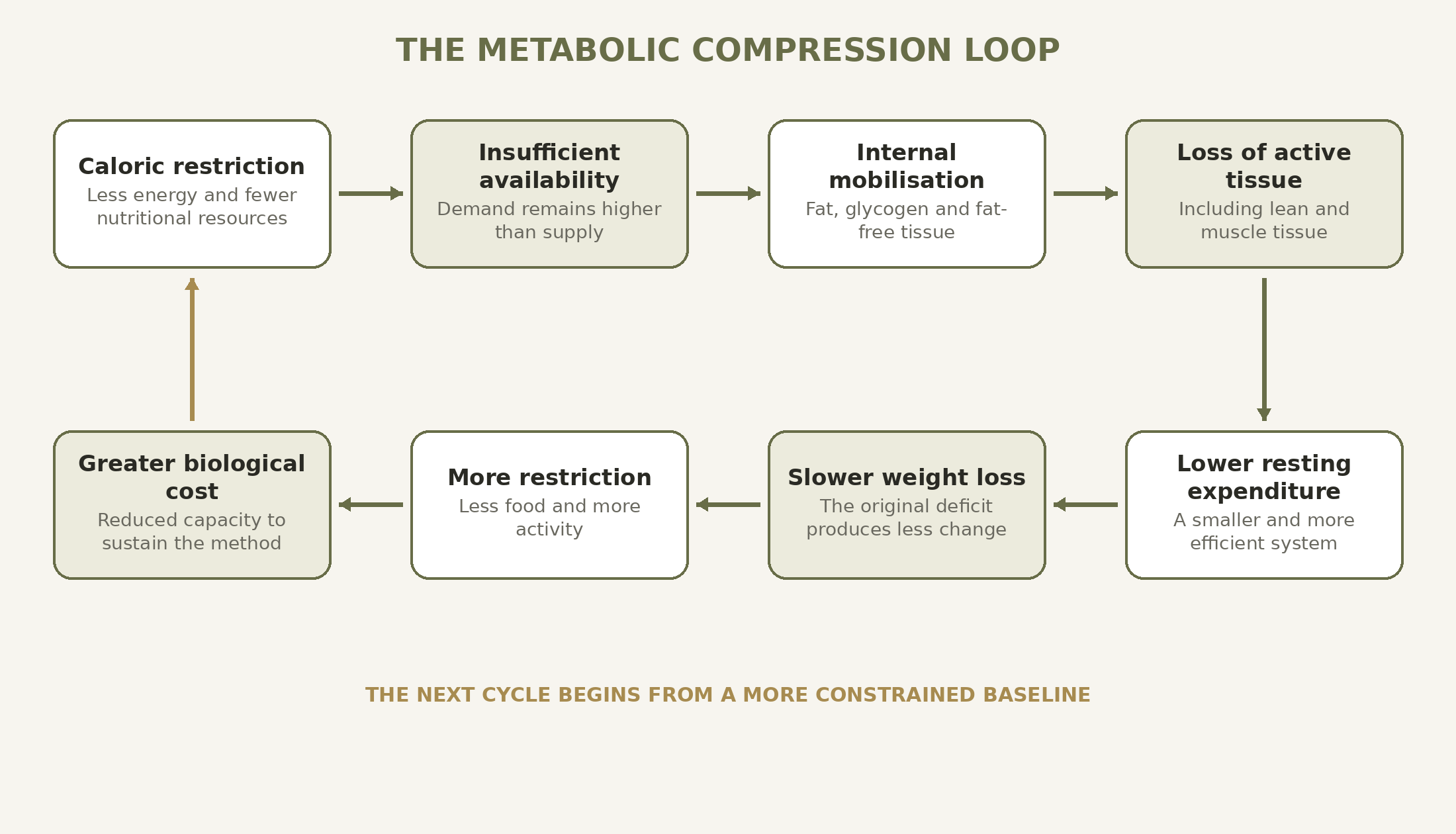
Fat-free mass is a major determinant of resting energy expenditure. When muscle and other metabolically active tissues are lost, the body becomes less energetically expensive to maintain.
Resting expenditure falls partly because there is less active tissue. It can fall further through adaptive thermogenesis: the system becomes more energy-efficient than predicted from the change in body composition alone. 1,13
The deficit that initially produced rapid weight loss therefore produces less change over time. The equation has changed because the system inside the equation has changed.
The standard response is to intensify the original instruction: reduce intake again, add more exercise, remove more foods and override more fatigue. The protocol becomes more aggressive as the organism becomes less capable of sustaining it.
FIGURE 1 | The metabolic compression loop
The Plateau Is an Adaptation
A plateau does not mean that the law of energy balance has stopped operating. It means that expenditure, tissue mass, movement, appetite and efficiency no longer occupy their original values.
Human energy-expenditure models demonstrate that weight change is dynamic. Fuel selection, body composition and expenditure adapt as weight changes. A fixed calorie calculation cannot represent this moving physiology. 1
Extreme interventions have produced particularly large and persistent reductions in resting metabolic rate. Those numerical results do not apply to every diet, but they establish the magnitude of adaptation possible when weight loss is rapid and severe. 13
A static prescription is being applied to a system that has already reorganised itself.
Hunger Rises While Energy Requirements Fall
Weight loss changes the signals that regulate hunger and satiety. Leptin, ghrelin, peptide YY, cholecystokinin and other mediators shift toward increased energy acquisition and reduced satiety.
In controlled research, several appetite-related hormonal changes and the subjective increase in hunger remained detectable one year after weight loss. 14
The person is therefore placed between opposing biological pressures. The smaller body requires less energy. Adaptive efficiency can reduce expenditure further. At the same time, hunger and food preoccupation increase.
Long-term maintenance can then require persistent restraint against a stronger drive to eat within a smaller energy allowance. The original diet has not resolved regulation. It has converted regulation into continuous restraint.
Restriction Teaches Compliance, Not Eating
A protocol organised around prohibition teaches temporary compliance. It does not teach nutritional competence.
It does not teach the person how to identify physiological needs, structure meals, use nutritional timing, protect muscle, create stable energy, respond to changing activity, distinguish hunger from dysregulated appetite, integrate pleasure or transition into maintenance.
The person learns which foods to avoid and how long deprivation must be tolerated. The rules belong to the diet, not to the life that must continue after it.
The protocol eventually ends because the target has been reached or because the biological, psychological and social cost has become unsustainable. The person then returns to what is described as normal eating. In practice, this can mean the habits that preceded the diet—the same meal structure, timing and choices that contributed to the original weight gain.
The old eating pattern returns to a body that no longer has the same metabolic capacity.
Regain Does Not Reconstruct What Restriction Removed
After a poorly protected restrictive diet, the person can have less fat-free mass, lower resting expenditure, stronger hunger, reduced spontaneous movement, disturbed satiety, greater food preoccupation and a diminished capacity to recover from stress.
When intake returns, fat stores can be replenished faster than muscle is rebuilt. Muscle restoration requires adequate protein, progressive mechanical stimulus, energy, sleep and recovery. It does not occur automatically because scale weight is returning.
When fat is restored before lean tissue, the previous body weight now represents a different composition: more fat, less muscle and lower metabolic capacity.
Systems analyses of human semi-starvation and refeeding show that a persistent fat-free-mass deficit can continue to stimulate food intake while fat stores are already being restored. Under those conditions, the attempt to complete lean-tissue recovery drives fat overshoot. 15
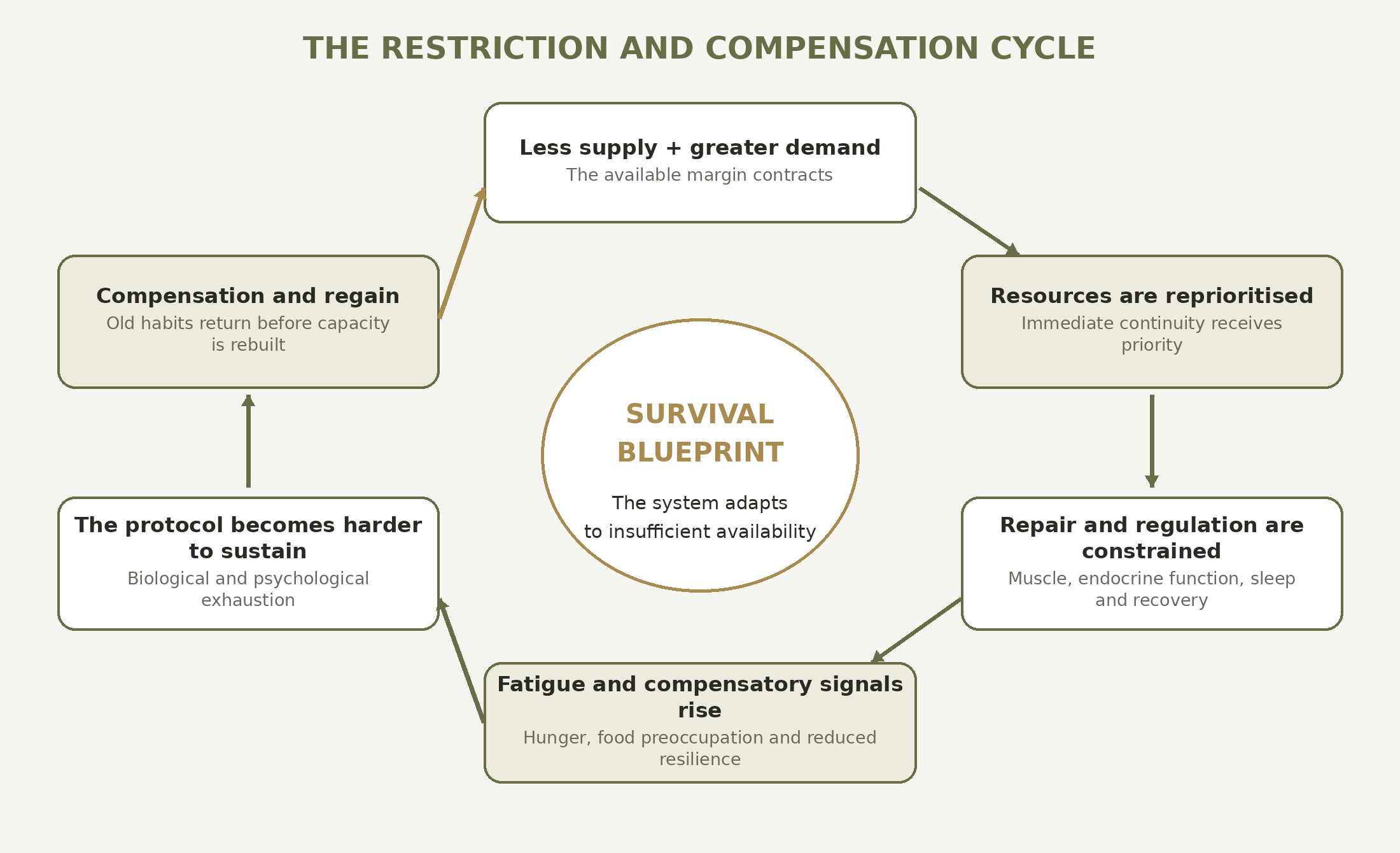
FIGURE 2 | The restriction and compensation cycle
Repeated Restriction Creates a More Constrained Starting Point
When each cycle includes lean-tissue loss, reduced expenditure, compensatory eating and fat-dominant regain, the next attempt begins from a less favourable baseline.
Restriction reduces available resources.
The system sacrifices part of its functional tissue and lowers expenditure.
Hunger and food preoccupation intensify.
The protocol becomes unlivable and compensation follows.
Weight returns before metabolic capacity is rebuilt.
The resulting pattern is not a failure to apply the same instruction with sufficient discipline. It is the predictable outcome of repeating an instruction that ignores the condition created by the previous cycle.
The Deficit Is Defined by What It Preserves
Energy reduction alone is not the relevant biological classification. The quality, magnitude, duration and structure of the deficit determine what the system must sacrifice to sustain it.
A coherent fat-loss strategy reduces excess while preserving the resources required for function. Protein remains sufficient. Essential fats remain available. Micronutrient density and fibre are protected. Carbohydrate is structured according to metabolic state and demand. Resistance stimulus communicates that muscle is still required. Sleep and recovery are treated as part of the intervention. The transition into maintenance is designed before the period of loss ends.
A deliberately structured fast or clinically supervised low-energy intervention belongs to the same standard: its indication, duration, nutritional context, monitoring and exit must be defined. It is not biologically equivalent to soup-only diets, lemonade protocols, indiscriminate meal skipping or eating almost nothing throughout the day before an uncontrolled evening meal.
Moderate calorie reduction can maintain nutritional adequacy when diet quality is deliberately protected. The safety does not come from the deficit itself. It comes from the structure surrounding it. 16
The decisive question is not how much food was removed. It is what remained available to the living system.
Pleasure and Variety Are Part of Regulation
A structure that excludes pleasure cannot become a stable way of eating.
Restrictive dieting divides food into two incompatible worlds: disciplined eating associated with results, and pleasurable eating associated with failure. The result depends on maintaining an opposition that everyday life will eventually dissolve.
Pleasure must be integrated into the structure that produces the result. Taste, texture, colour, gourmandise and social connection are not separate from nutritional coherence. They determine whether the behaviour can become part of life rather than remain a temporary performance.
Variety also expands biological coverage. Different foods provide different amino acid profiles, fatty acids, fibres, vitamins, minerals, polyphenols, pigments and plant compounds. Monotony narrows both nutritional exposure and behavioural sustainability.
Health and pleasure stop competing when nutrition is organised with precision.
Biological Coherence Changes the Strategy
Biological coherence does not seek the lowest intake the person can tolerate. It creates the conditions in which excess fat can be mobilised without forcing the organism to degrade the capacities required to maintain the result.
The strategy begins with the state of the system and aligns the main determinants of that state: nutritional density, protein, satiety, meal timing, circadian rhythm, movement, muscle stimulus, sleep, stress load, recovery and the realities of the person’s life.
What must be reduced is reduced. What must be protected is protected. What has been depleted is restored. The person learns how to adjust rather than how to obey.
Under those conditions, fat loss no longer requires nourishment, pleasure, cognitive performance and physiological stability to compete for the same result.
Regulation replaces restriction.
Biological coherence restores the conditions required for energy regulation: sufficient structural resources, stable signalling, preserved muscle, functional endocrine communication, restorative sleep and the capacity to recover from demand.
Within those conditions, excess fat can be mobilised without progressively dismantling the metabolic infrastructure required to maintain the result.
A durable outcome is measured by both the fat that has been lost and the biological capacity that remains — stable energy, regulated appetite, preserved function, cognitive clarity, recovery and a body composition the system can sustain within life.
The durability of the result is determined by the state of the system that must carry it.
Scientific References
Hall KD. Predicting metabolic adaptation, body weight change, and energy intake in humans. American Journal of Physiology-Endocrinology and Metabolism. 2010;298(3):E449-E466. doi:10.1152/ajpendo.00559.2009.
Chaston TB, Dixon JB, O’Brien PE. Changes in fat-free mass during significant weight loss: a systematic review. International Journal of Obesity. 2007;31:743-750. doi:10.1038/sj.ijo.0803483.
Heymsfield SB, Gonzalez MCC, Shen W, Redman L, Thomas D. Weight loss composition is one-fourth fat-free mass: a critical review and critique of this widely cited rule. Obesity Reviews. 2014;15(4):310-321. doi:10.1111/obr.12143.
Longland TM, Oikawa SY, Mitchell CJ, Devries MC, Phillips SM. Higher compared with lower dietary protein during an energy deficit combined with intense exercise promotes greater lean mass gain and fat mass loss: a randomized trial. American Journal of Clinical Nutrition. 2016;103(3):738-746. doi:10.3945/ajcn.115.119339.
Pasiakos SM, Cao JJ, Margolis LM, et al. Effects of high-protein diets on fat-free mass and muscle protein synthesis following weight loss. FASEB Journal. 2013;27(9):3837-3847. doi:10.1096/fj.13-230227.
Goette DK, Odom RB. Alopecia in crash dieters. JAMA. 1976;235(24):2622-2623. PMID:946869.
Karl JP, Thompson LA, Niro PJ, et al. Transient decrements in mood during energy deficit are independent of dietary protein-to-carbohydrate ratio. Physiology & Behavior. 2015;139:524-531. doi:10.1016/j.physbeh.2014.11.068.
Kim AE, Shekhar S, Hirsch KR, et al. Caloric restriction, the menstrual cycle, and sleep in women without obesity. Journal of Clinical Endocrinology & Metabolism. 2025;110(11):3108-3119. doi:10.1210/clinem/dgaf145.
Loucks AB, Verdun M, Heath EM. Low energy availability, not stress of exercise, alters LH pulsatility in exercising women. Journal of Applied Physiology. 1998;84(1):37-46. doi:10.1152/jappl.1998.84.1.37.
Loucks AB, Thuma JR. Luteinizing hormone pulsatility is disrupted at a threshold of energy availability in regularly menstruating women. Journal of Clinical Endocrinology & Metabolism. 2003;88(1):297-311. doi:10.1210/jc.2002-020369.
Sim A, Tan HQ, Ali Y, Burns SF. Manipulating energy availability in male endurance runners: a randomised controlled trial. Applied Physiology, Nutrition, and Metabolism. 2024. doi:10.1139/apnm-2024-0037.
Ihle R, Loucks AB. Dose-response relationships between energy availability and bone turnover in young exercising women. Journal of Bone and Mineral Research. 2004;19(8):1231-1240. doi:10.1359/JBMR.040410.
Fothergill E, Guo J, Howard L, et al. Persistent metabolic adaptation 6 years after The Biggest Loser competition. Obesity. 2016;24(8):1612-1619. doi:10.1002/oby.21538.
Sumithran P, Prendergast LA, Delbridge E, et al. Long-term persistence of hormonal adaptations to weight loss. New England Journal of Medicine. 2011;365:1597-1604. doi:10.1056/NEJMoa1105816.
Dulloo AG. Physiology of weight regain: lessons from the classic Minnesota Starvation Experiment on human body composition regulation. Obesity Reviews. 2021;22(S2):e13189. doi:10.1111/obr.13189.
Racette SB, Das SK, Bhapkar M, et al. Nutritional quality of calorie-restricted diets in the CALERIE 2 trial. Nutrients. 2022;14. PMID:35643360.